
Top tips for teaching yourself the piano in 2025
Discover essential tips for teaching yourself piano in 2025, from finding your inspiration to choosing the right instrument and developing your own practice strategies.
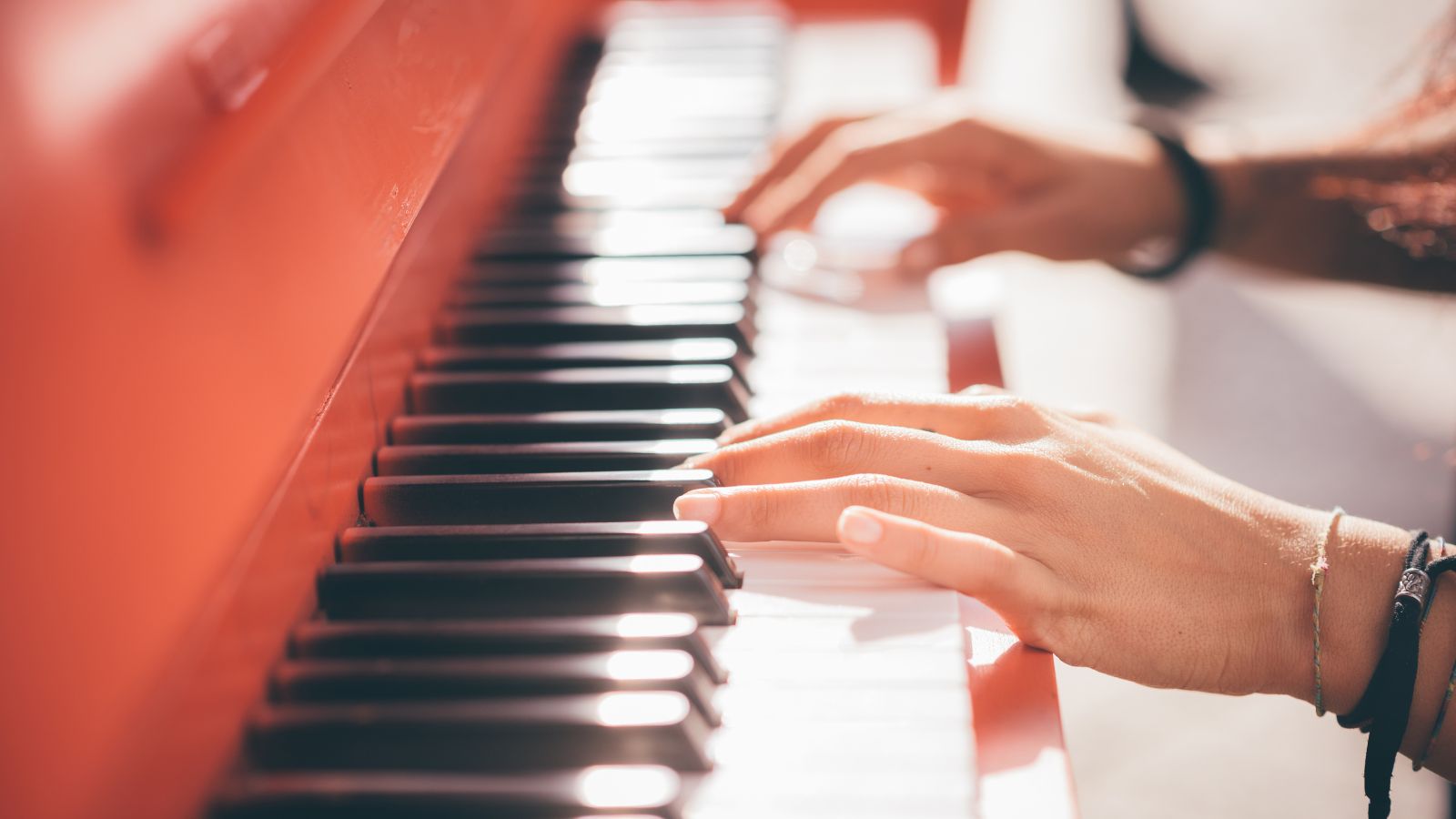
So you’ve decided to learn piano! Congratulations — making the decision is the first step in this exciting and rewarding journey. Not sure how and where to start as a beginner? We’ve got some tips on teaching yourself the piano.
Top tips on teaching yourself the piano:
1. Name your inspiration: Why do you want to learn piano?
You’re most likely here because you’ve been inspired already. Maybe it was a song or an artist, or perhaps you’re captivated by the vast musical possibilities of the instrument. You might even be searching for easy piano songs for beginners.
Whatever it is, ask yourself, Why do I want to start teaching myself the piano? Try to identify that inspiration, even if it’s just a vague feeling.
Learning piano (or any instrument) will have its challenging moments. When you encounter frustrating — and temporary — hurdles, recalling these inspirations will help you refocus on the bigger picture. Using fundamental music tools like a metronome, or a vibrating metronome like the Pulse, will help you build a strong foundation.
2. Name your aspirations
Your inspirations will help identify your aspirations: Do you want to play Stevie Wonder songs? Do you want to learn to improvise? Aspire to become a concert pianist? Or do you want to explore electronic sounds for writing purposes?
Even if it's something like "making beautiful music," identify what makes something beautiful to you.
We’ve listed some things you should probably prioritize in your learning, based on genre:
Your goals and inspirations can change along the way, and that’s okay! Just remember our Soundbrenner mantra: Musicians aren't born — they're crafted from practice.
Ultimately, your growth as a musician is about developing your own artistic taste and sensibilities.
3. Choose your instrument
Now let's get into it: how do you teach yourself piano? Obviously, you'll need an instrument. There are plenty of options out there, and it can get overwhelming, but here's our breakdown.
There are mainly three categories for teaching yourself the piano:
Digital keyboard
Sometimes called Electric Keyboard. These are physically minimal instruments. Sounds are synthetic or sampled. They come with adjustable volume and often include features like different instrument sounds, metronome, and even drum tracks to play along with.
Two important factors:
How the keys feel
- The keys on an acoustic piano offer natural resistance, allowing for variety and nuance in your sound — loud, soft, harsh, smooth, etc. Digital keyboards can replicate that resistance and sonic response to varying degrees. The closest (and more expensive) replicas will have hammer action, which mimics the actual hammer mechanism of an acoustic piano, or weighted keys. There are also semi-weighted or unweighted options: Semi-weighted keys have a lighter and quicker feel, which could work better for modern sounds. Unweighted keys are the cheapest option, but they won’t provide much color.
Number of keys
- The number of keys affects the length of your keyboard. The full range has 88 keys (7 octaves) and can produce satisfying low bass notes or twinkly high notes. The next largest has 76 keys (6 octaves), which is sufficient for most songs, especially beginner ones, and is a decent option if limited by space or cost. You’ll likely encounter the lower and upper ends with most pieces with 61 keys (5 octaves) or fewer, but remember, creativity can thrive within limits.
Digital piano
Sturdier than the digital keyboard, a digital piano is designed to emulate the acoustic piano. It is more expensive and will have similar features to a digital keyboard, like different sounds and adjustable volume.
Unlike the digital keyboard, which is placed on a separate stand, a digital piano often comes with a sturdier frame and attached pedals. It has the full range of 88 keys and will feel and sound close to an acoustic piano, with hammer action, although the sounds are still sampled.
Acoustic
The traditional, stringed instrument. Wooden hammers strike the strings when the keys are played, producing the sound you hear.
No digital instrument can truly replicate the tactile vibrations of an acoustic instrument! (And you know we’re all about the good vibrations.) However, with technology advancing quickly, some digital instruments may feel and sound better than low-end acoustic pianos.
If you choose a digital option, try to play an acoustic piano occasionally (at a music shop, practice room, community center, etc.) to understand what your digital instrument is trying to replicate.
N.B. You might also see stage pianos around — those are tailored for live performances and are not recommended for beginners.
4. Be your own teacher (even if you have one already)
With various ways to learn piano today — private teachers (in-person and online), YouTube tutorials, apps, or books — it comes down to what works best for you. Each has its pros and cons, with varying degrees of personalized guidance, convenience, and cost, and all are valid ways to learn piano.
However, when you practice alone, you only have your own ears to rely on — and that’s when you become your own teacher.
Being your own teacher means actively listening to yourself, constantly reflecting on and evaluating your playing — and learning to do so is an essential part of your journey as a musician.
You’ll need to ask yourself: Does this sound good? More specifically, is this quality of sound what I want? Does this section need to be more rhythmic, or can it be more relaxed? Or simply hold yourself accountable and say, I need to fix this problem spot.
Remember, what’s “good” is subjective. Some opinions might be more popular and conventional than others, but ultimately, what sounds good is your call. Teachers can offer their evaluation and teach you how to play “better.” However, your growth as a musician is about developing your own artistic taste and sensibilities through active listening, influence from other artists, and your imagination.
5. Learn practice techniques and strategies
Now you know what adjustments you want to make, but how do you get there? This is where practice techniques and strategies come in.
In addition to general practice strategies, like practicing slowly with a metronome, a piano-specific strategy is separating your left and right-hand coordination.
If you’re working through a difficult passage, practice each hand separately before putting them together. Get to a point where it’s ingrained in your muscle memory — that way, it’ll be easier when both hands come together.
Developing good fingering is also fundamental.
6. Please don’t stop the music
Finally, learning technique and theory might get overwhelming — but remember, you’re making music! Don’t forget to enjoy the sounds, melodies, harmonies, and rhythms you’re creating.
Learning the piano is an incredibly rewarding experience, and we hope this empowers you to take further steps in your piano-learning journey. We're sending you all the good vibes!
Check out more practice tips here
About Soundbrenner
We're on a mission to make music practice addictive. Our products are the ultimate companion for every practice session. And they're made for you. We serve all musicians, across all instruments and from beginners to professionals. Click here to learn more.
Do you have a question about Soundbrenner or our products? Contact us, we'd love to hear from you!
Read this next


Wave in-ear monitors
Stop settling for bad audio: Why the Soundbrenner Wave IEM changes everything for casual listeners too
Nov 14, 2025


